
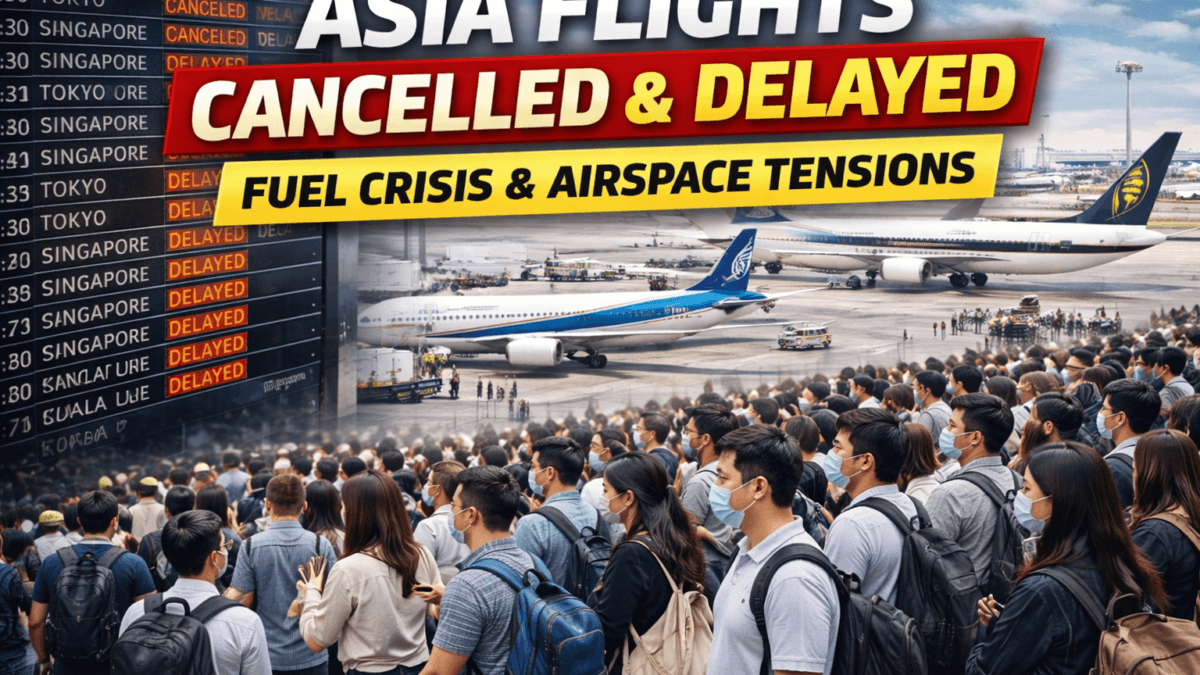
Air travel across Asia is facing a major disruption in April 2026, with hundreds of flights cancelled and thousands delayed, affecting passengers across key international hubs. From India to Southeast Asia and the Middle East corridors, the aviation sector is currently battling one of its most complex operational crises in recent years.
According to latest reports, over 500 flights have been cancelled and more than 6,000 delayed across Asia, highlighting the scale of the disruption and its growing impact on global travel networks.
What’s Causing the Asia Flight Disruptions?
Experts say the current crisis is not caused by a single factor but a combination of global and regional issues hitting the aviation industry simultaneously.
1. Middle East Conflict & Airspace Restrictions
The ongoing geopolitical tensions in the Middle East have forced airlines to avoid key air routes, leading to longer flight paths and scheduling disruptions.
Airlines are rerouting flights to bypass conflict zones, increasing travel time and operational pressure. This has significantly affected routes connecting Asia with Europe and West Asia.
2. Jet Fuel Crisis Intensifies
One of the biggest hidden reasons behind the disruption is a global jet fuel shortage. The Strait of Hormuz—critical for fuel supply—has seen severe disruptions, impacting aviation fuel availability.
Airlines across Asia are:
- Cutting flights
- Carrying extra fuel (tankering)
- Increasing ticket prices
This has forced several carriers to reduce schedules or cancel routes entirely.
3. Weather-Related Disruptions
Extreme weather conditions have also played a role. For example, strong winds recently forced dozens of flight cancellations at Sydney Airport, showing how weather continues to disrupt operations.
Weather-related delays, when combined with already tight schedules, are causing a ripple effect across airports.
4. Air Traffic Congestion & Network Pressure
Asia’s aviation network is highly interconnected. A delay in one hub can quickly affect multiple routes.
Major airports like:
- Tokyo
- Hong Kong
- Shanghai
- Dubai
have seen cascading delays, as high passenger demand and reduced airspace availability create bottlenecks.
Passengers Facing Major Inconvenience
The disruption has left thousands of passengers stranded across airports. Travelers are dealing with:
- Missed connecting flights
- Long waiting times
- Last-minute cancellations
- Increased travel costs
Many passengers have reported confusion due to limited communication from airlines, while others struggle to find alternative flights amid high demand.
Airlines Under Pressure
Airlines are now operating under extreme stress as they try to manage schedules and passenger expectations.
Several carriers have:
- Reduced flight frequencies
- Cancelled unprofitable routes
- Increased fuel surcharges
- Reallocated aircraft to stable routes
In India alone, over 10,000 flights to West Asia have been cancelled in recent weeks, reflecting the severity of the situation.
Wider Impact on Travel and Economy
The ongoing disruption is not just affecting passengers—it is also impacting the broader economy.
- Tourism sectors in countries like Thailand and UAE are facing uncertainty
- Business travel is being disrupted
- Airlines are seeing rising operational costs
- Ticket prices are increasing due to fuel expenses
Experts warn that if the situation continues, it could lead to long-term instability in global aviation pricing and schedules.
What Happens Next?
Industry analysts believe that disruptions may continue in the coming weeks unless:
- Geopolitical tensions ease
- Fuel supply stabilizes
- Airspace restrictions are lifted
Airlines are gradually adapting, but full recovery could take time due to the scale of interconnected disruptions.
What Travelers Should Do
Passengers planning travel in the coming days are advised to:
- Check flight status before leaving for the airport
- Arrive early due to congestion
- Keep alternative travel plans ready
- Stay updated via airline apps and alerts
Conclusion
The Asia flight disruption crisis of 2026 highlights how global conflicts, fuel shortages, and operational pressures can combine to impact air travel on a massive scale.
With thousands of passengers affected and airlines struggling to keep up, the situation remains fluid. For now, flexibility and preparedness are key for travelers navigating this uncertain phase in aviation.